

The importance of structured data has grown rapidly in modern SEO, especially as search engines become more focused on understanding meaning rather than just matching keywords.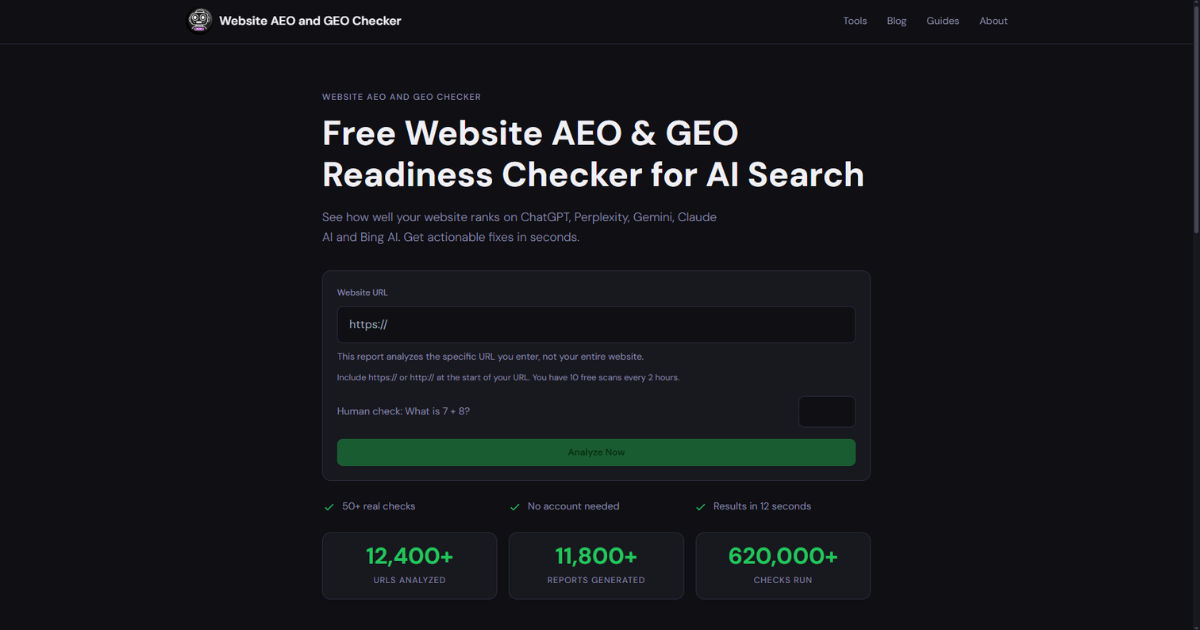
One of the most effective tools in this space is schema markup, which directly supports Answer Engine Optimization (AEO). In this guide, we will explore why website AEO schema helps search engines and how it improves visibility, indexing, and ranking.
You will also learn how tools like the Free Website AEO Checker can help you validate and optimize your schema for better performance.This article is written in a simple, easy-to-understand way so that even a 12th-grade student can grasp how schema works and why it matters in SEO today.
Throughout this guide, we will also naturally explore how the Free Website AEO Checker plays a role in analyzing structured data and improving search performance.
Website AEO Schema
Website AEO schema is a type of structured data that helps search engines understand the meaning and context of content on a webpage. Instead of relying only on visible text, schema provides additional machine-readable information.
For example:
- A blog post can be labeled as an “Article”
- A business can be marked as an “Organization”
- A question page can be identified as “FAQPage”
This structured format helps search engines interpret content correctly.
When combined with modern search behavior, AEO schema becomes essential for visibility in featured snippets, voice search, and AI-generated answers.
The Free Website AEO Checker is often used to analyze whether this schema is correctly implemented and readable by search engines.
How Website AEO Schema Helps Search Engines Understand Content
Search engines like Google use bots to crawl billions of pages. Without structured data, they rely heavily on context clues from text. Schema removes confusion by providing direct meaning.
Clear Content Classification
Schema tells search engines exactly what a page represents. For example:
- Product pages are clearly identified
- Articles are separated from landing pages
- FAQs are recognized instantly
This reduces guesswork and improves indexing accuracy.
Better Context Understanding
Instead of just reading words, search engines understand relationships between elements:
- Who wrote the content
- What the topic is about
- When it was published
- What category it belongs to
This semantic clarity is a core reason why website AEO schema helps search engines perform better.
Using a Free Website AEO Checker ensures these relationships are properly structured.
Improving Search Engine Indexing with Schema
Indexing is how search engines store and organize content. Schema markup improves this process significantly.
Faster Crawling and Interpretation
When schema is present, search engines do not need to analyze every sentence deeply. Instead, they can quickly identify:
- Page type
- Key entities
- Important attributes
This speeds up indexing and reduces errors.
Reduced Misinterpretation
Without schema, a page about “Apple” could mean:
- A fruit
- A technology company
Schema removes this confusion by defining context clearly.
This is another reason why website AEO schema helps search engines deliver more accurate results.
The Free Website AEO Checker is useful for detecting missing or incorrect schema that may confuse crawlers.
Schema and Rich Search Results
One of the most visible benefits of schema is rich results. These are enhanced listings that appear in search engines.
Examples of Rich Results
- Star ratings
- FAQs under search results
- Product pricing
- Event details
- Article previews
These features make listings more attractive and increase click-through rates.
Why Rich Results Matter
Rich results help search engines:
- Present better answers
- Increase user satisfaction
- Improve engagement signals
This directly connects to why website AEO schema helps search engines improve user experience.
A Free Website AEO Checker can test whether your pages qualify for rich results.
Semantic SEO and Answer Engine Optimization
AEO (Answer Engine Optimization) focuses on helping content appear as direct answers in search engines and AI systems.
Schema plays a major role in this process.
How Schema Supports AEO
- It defines question-answer relationships
- It highlights important content sections
- It improves eligibility for featured snippets
Search engines increasingly use structured data to generate instant answers.
That is why website AEO schema helps search engines shift from keyword matching to meaning-based retrieval.
The Free Website AEO Checker is widely used to ensure content is optimized for these answer-based systems.
Entity Recognition and Knowledge Graphs
Search engines build knowledge graphs to understand real-world entities like people, places, and organizations.
How Schema Supports Entities
Schema helps define:
- Brand names
- Authors
- Locations
- Products
This allows search engines to connect your website with broader knowledge systems.
For example:
A blog about digital marketing can be linked to topics like SEO, advertising, and analytics.
This deeper understanding is a key reason why website AEO schema helps search engines build better knowledge networks.
A Free Website AEO Checker can help identify missing entity markup that affects visibility.
Types of Schema That Improve AEO
Different schema types serve different purposes. Here are the most important ones:
Article Schema
Used for blog posts and news content. It helps search engines understand:
- Title
- Author
- Publish date
FAQ Schema
Used for question-based content. It increases chances of appearing in featured snippets.
Organization Schema
Helps define a company or brand identity.
Product Schema
Important for e-commerce websites. It includes:
- Price
- Availability
- Reviews
Breadcrumb Schema
Helps structure site navigation for search engines.
Each of these contributes to why website AEO schema helps search engines interpret content more effectively.
The Free Website AEO Checker can validate all these schema types for correctness.
How Schema Improves Voice Search
Voice search is growing rapidly with tools like Google Assistant and Siri. These systems rely heavily on structured data.
Why Schema Matters for Voice Search
Voice assistants prefer:
- Short answers
- Clear definitions
- Structured information
Schema helps provide exactly that.
For example, if someone asks:
“What is SEO?”
A page with proper schema is more likely to be selected as the spoken answer.
This is another strong reason why website AEO schema helps search engines adapt to voice-based queries.
The Free Website AEO Checker ensures your content is ready for voice search optimization.
Common Mistakes in Schema Implementation
Even though schema is powerful, many websites use it incorrectly.
Missing Required Fields
Some pages forget important properties like:
- Author name
- Date published
Incorrect Formatting
JSON-LD errors can prevent schema from working properly.
Overuse of Schema
Adding irrelevant schema can confuse search engines instead of helping.
Not Updating Schema
Old or outdated schema can reduce performance.
Using a Free Website AEO Checker regularly helps avoid these mistakes.
Best Practices for Website AEO Schema
To get the best results, follow these practices:
Keep Schema Relevant
Only use schema that matches the page content.
Use JSON-LD Format
This is the preferred format by Google.
Validate Regularly
Always test your schema using tools like the Free Website AEO Checker.
Keep Information Updated
Make sure your schema reflects the latest content changes.
Focus on User Intent
Schema should support how users search and what they expect.
Following these practices strengthens why website AEO schema helps search engines deliver better results.
How to Test Schema Effectively
Testing is a critical step in SEO optimization.
Manual Testing
You can use Google’s Rich Results Test tool.
Automated Testing Tools
Tools like the Free Website AEO Checker provide deeper insights such as:
- Schema errors
- Missing tags
- Optimization suggestions
Continuous Monitoring
SEO is not a one-time task. Regular checks ensure consistent performance.
Future of AEO Schema in Search Engines
Search engines are evolving toward AI-driven systems that rely heavily on structured data.
AI Search and Schema
AI systems use schema to:
- Understand context
- Generate answers
- Summarize content
Increased Importance of Structured Data
In the future, websites without schema may struggle to compete.
Integration with Generative AI
Search engines may use schema to generate AI-powered search summaries.
This evolution shows clearly why website AEO schema helps search engines become more intelligent and user-focused.
The Free Website AEO Checker will likely become even more important as AI search grows.
Conclusion
Website AEO schema is one of the most powerful tools for improving how search engines understand and display web content. It enhances indexing, improves rich results, supports voice search, and strengthens semantic understanding across the web.
By implementing structured data correctly, websites can communicate more clearly with search engines and increase their chances of ranking higher in search results. This is exactly why website AEO schema helps search engines evolve from simple keyword matching systems into advanced meaning-based engines.
Tools like the Free Website AEO Checker play an essential role in this process by helping website owners validate, fix, and optimize their structured data for maximum performance. As search technology continues to evolve, especially with AI and voice search, schema will become even more important for digital visibility.
In short, structured data is not just a technical SEO feature—it is the foundation of modern search understanding.